Let’s be honest. You and me, we’ve been burned.
We picked up the bass a while ago, figured out the basics, and then hit the wall—hard. You were probably excited, maybe even a little cocky, thinking, “How hard can this be? It’s only four strings!” You hit that open E string and new your were destined for bass goodhood. Then you started watching YouTube videos. One minute you’re trying to nail the opening riff to “Another One Bites the Dust,” and the next, a guy in a fedora is casually explaining his tapping technique with the Locrian mode on a $10,000 boutique bass.
Then you decided to get serious and started buying online bass courses. I know the drill because I’m a professional course buyer—it’s my only real qualification. I’ve spent hundreds, maybe thousands (I really shouldn’t do the math), trying to separate the good from the useless. I was looking for the fast lane to “above average,” but instead, I found the scenic route full of technical jargon, dry professors, and overly chatty instructors. It’s frustrating to pay good money for a course that feels designed for music school grads, not for a regular person who just wants to nail a decent groove after work.
I started this site because I needed an honest guide, and since I couldn’t find one, I decided to become one. My promise is simple: I only review what I’ve paid for, tested, and genuinely believe will help the average player level up.
Full disclosure, because I promised honesty: Some links below are affiliate links. If you purchase a course through them, I get a small commission. This helps keep the lights on here at AboveAverageBass.com, but rest assured, my reviews come from my own paid experience, not from a sales pitch. I’m your guinea pig.
The Big Question – Which Online Bass Course is Best?
So, which online bass platform actually works? Which one will take your hands out of the beginner bucket and help you become a genuinely Above Average player? That’s why we’re here. Let’s put the three biggest names—Scott’s Bass Lessons (SBL), BassBuzz, and TalkingBass—to the ultimate test: which platform is the fastest, least frustrating, and best value for the dedicated, self-taught player?
Tomplay at a Glance
| Feature | Focus | Best For |
| Primary Use | Playing interactive sheet music | Timing, sight-reading, and motivation |
| Best For | Learners who struggle with motivation | Applying theoretical knowledge to real songs |
| Pricing Model | Monthly or annual subscription | Regular, motivated users |
| Core Customization | Speed, Looping, Track Mute | Above Average tackling difficult passages |
Individual Deep Dives
Now that the skimmers have their fix, it’s time to get into the details. I have personally paid for and put in the hours on all three of these platforms, which means you get the real-world, no-fluff breakdown.
BassBuzz (The Fun & Focused Path)

The Pitch: Who is Josh and what is the “Beginner to Badass” promise?
Josh from BassBuzz is the guy who looks like he genuinely wants you to succeed. He’s not trying to show you how fast he can slap; he’s trying to show you how fast you can learn. His flagship course, “Beginner to Badass” (B2B), isn’t a humble name—it’s a promise. The entire premise is to take you from never having touched a bass to playing real songs with a decent groove, all on a clear, no-detour path.
I started B2B after wasting a few months on scattered YouTube videos. Honestly, I found some of the early material to be a little too simple because I already had some music theory knowledge. I didn’t know how to play bass, but I knew note types, time signatures, and the other basics. But I stuck with the path, and that’s the magic. Josh excels at building a rock-solid foundation that most self-taught players—the “average” ones like us—skip over entirely. He breaks everything down to the absolute beginner perspective. I appreciate that there’s just one main course here; it forces you to focus your efforts instead of getting overwhelmed.
Structure & Content: Is it truly start-to-finish?
Yes, B2B is the definition of start-to-finish. The course is laid out logically and easy to follow, almost like a school semester, but way more fun. You move through modules covering everything from holding the bass correctly and muting the strings (critical, and often overlooked!) to understanding essential scales and intervals.
The content is focused on practical application. You’re not just memorizing the circle of fifths; you are applying basic skills immediately to real-world bass lines and songs. This is crucial for keeping motivation high. I remember hitting a wall trying to figure out timing, and the B2B lesson on rhythm felt like the first time a teacher actually explained why the subdivision matters, not just what the subdivision is. Pairing the lessons with real world songs (and cool ones too, not “Mary Had a Little Lamb”), shines a bright light on why you’re learning what he’s teaching.
Warning! Somewhere around week 2 or 3 of the course, Josh throws the bass line from Michael Jackson’s “Billy Jean” at you. If you are anything like me, this is going to drive you crazy. When you’re still new to the bass, this line is a real finger twister and can make you doubt all of the progress you feel like you’ve made. Honestly, I get why Josh does it. He wants to push his students and to give them something that they can go back to at the end of the course to see how much they’ve accomplished in their bass journey, but in the moment it can be a real morale killer. If it gets to you too much, just move on and try it again in a week or two.
The Vibe Check (The Above Average Review): Relatable or distracting?
Josh’s humor and goofy production are either your favorite thing or your least favorite thing. For me, it was a breath of fresh air. After dealing with the academic, dry lessons from other sites, Josh’s encouragement and lightheartedness were exactly what I needed to keep the momentum going. I didn’t feel like I was taking a college course; I felt like I was learning from a friend who occasionally makes a terrible pun. The “fast progress” model definitely works because the lessons are so engaging and digestible. You finish one and immediately want to click the next button. (Or even better…actually get out there and jam!)
The only real caution for the Above Average player is this: if you’re coming in with any music background, some of the early sessions will feel too simple for a while. You might be tempted to skip ahead, but trust me, completing the course as designed pays off in the long run. The flip side is that once the course is over, you might find yourself wanting a bit more to continue progressing past that intermediate level.
If you’ve finished Beginner to Badass (or want to check an alternative), check out my review of Pickup Music — my top pick for where to go after BassBuzz.
This Rocks!
This Falls a Little Flat
- Josh is a genuinely great teacher, with lots of humor, making the experience encouraging and fun.
- The course is logically laid out and easy to follow.
- It really starts from the true beginner perspective.
- One course really lets you focus your efforts.
- Apply learning to real songs.
- Top notch customer service and a money back guarantee.
- If you’re coming in with any music background, some of the early sessions will be too simple.
- The course may end with you wanting a bit more to continue progressing past intermediate.
Conclusion: My Top Pick for the True Beginner
Best For: The absolute beginner or the stalled intermediate player who needs a highly structured, fun, and clear path to build a rock-solid foundation, without getting lost in a huge content library.
TalkingBass (The No-Nonsense Professor)
The Pitch: Who is Mark Smith? Why is his approach different?
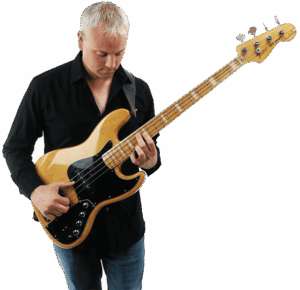
Mark Smith from TalkingBass is the Professor of Bass. Where BassBuzz offers you the fun, guided tour, TalkingBass hands you a syllabus and tells you to take notes. Mark’s approach is the polar opposite of the “fast and fun” mentality—it’s less fluff and more academic.
If you are a player who finds yourself stuck, not because of a lack of motivation, but because you just don’t understand why the notes you play sound good (or bad), Mark is your guy. His instruction is built on a foundation of very strong technical training with a focus on music theory. He is the perfect antidote to the “play by tab” mentality. His focus on theory, fingerboard navigation, and proper technique is what separates the average player from the truly knowledgeable one.
Structure & Content: The individual course model
TalkingBass doesn’t use a subscription model. Instead, Mark sells dozens of individual courses, which can be both a blessing and a curse. The blessing is that you only pay for exactly what you need. Want to crush the “Music Theory for Bass module? Buy that. Want to focus purely on walking bass? Buy that course. The curse is that, for the intermediate player, the sheer variety of courses on many different bass topics can be a bit overwhelming, making it hard to figure out the right sequence to purchase. Also, while the courses are certainly cheaper than you would pay for similar amounts of time with a personal instructor, they do add up. Fortunately, one course will provide you with dozens of hours of material.Also, Mark has a selection of free courses to try out and a variety of YouTube videos.
I dove into Chord Tone Essentials after watching a few of Mark’s YouTube videos. I have to say, the depth and clarity are unmatched. He doesn’t just name the intervals; he meticulously walks you through how to use them to create interesting bass lines. This is the stuff that gets you to Above Average. However, this intensive focus and serious tone could be intimidating for a true beginner.
The Vibe Check (The Above Average Review): Too dry for the casual learner?
Yes, the vibe is less “friendly” and more “just the facts”. There’s very little of the playful banter or high-production humor you find on BassBuzz. Mark is a serious man with a serious dedication to bass education. If you are easily turned off by material that feels like homework, this might not be the right fit. You need to be the kind of learner who wants the deep theory knowledge and is willing to put in the time to justify the cost.
My personal anecdote here is about a lesson on fretboard knowledge. I was trying to map out a tricky scale and kept getting lost. Mark’s detailed, step-by-step videos on fingering positions were the only thing that finally made it click for me. No humor, no flash, just pure, unadulterated knowledge. That said, it’s a mental load and you may need to mix it up with other purely “fun” bass activities.
This Rocks!
This Falls a Little Flat
- Very strong technical training with a focus on music theory.
- A wide variety of courses on many different bass topics.
- The instruction has less “friendly” vibe, more “just the facts”.
- Could be intimidating for a true beginner.
Conclusion: When You’ve Got a Specific Topic To Work On
Best For: The highly self-motivated, intermediate to advanced player who wants to truly master music theory and technique, and prefers deep, academic instruction over an encouraging, entertaining vibe.
Scott’s Bass Lessons (The Buffet of Bass Knowledge)

The Pitch: What is SBL’s huge library and “Players Path”?
Scott’s Bass Lessons (SBL) is the bass education industry leader for a reason: sheer volume. If BassBuzz is the focused path and TalkingBass is the specialized library, SBL is the all-you-can-eat, five-star buffet of bass education. For a single monthly or annual subscription, you get access to a massive library covering everything from beginner to professional levels.
Their core offering is the Players Path, a structured curriculum meant to guide you. However, the real draw is the colossal volume of content, including a wide variety of courses—from their full scope “Pathways” to more specific niche programs such as slap, theory, and fretboard mastery. Plus, it’s not just Scott—you get lessons from a variety of teachers, including some famous, working bass professionals such as Michael League, Sean Hurley, and Charles Berthoud.
Structure & Content: The challenge of finding a path without getting lost
While the Players Path attempts to be a clear guide, the structure is challenging for the easily distracted. Picture a library with 50,000 books and a single librarian who just points toward the back wall. Yes, the path is there, but the sheer volume of other, shiny courses is a constant distraction.
The quality of the content is consistently high. The lessons are detailed, well-produced, and the variety of instructors and perspectives is a major plus. I found their beginner Players Path course to be incredibly helpful, taught by an absolute master, but I had to actively force myself to not check out the jazz theory course right after, simply because the content overload is real. They also provide lots of extra content and materials such as an app, podcast, interviews, and community.
The Vibe Check (The Above Average Review): Is the community worth the price?
Scott himself is a passionate and motivating teacher. Yes, some people find him “too talky”, but I view his enthusiasm as part of the package. He genuinely wants to build a huge community and often succeeds. Ian Martin Allison has become almost as emblematic for the platform as Scott. The two have an obvious friendship that I find welcoming.
The community is arguably the biggest selling point and a huge factor in the subscription price. Having access to a forum of other dedicated players, and occasional feedback from instructors, is invaluable. However, be aware that some find the overall marketing—especially the constant email pushes—to be a little aggressive and overwhelming. Although people on reddit love to complain about SBL’s marketing, I find it easy enough to just delete or unsubscribe if it is too much.
For the Above Average player, SBL offers the highest ceiling. The content available at the high-intermediate and advanced levels is exceptional, thanks to the variety of expert instructors. But for me, the cost of the courses and the ongoing membership definitely add up over time.
This Rocks!
This Falls a Little Flat
- A wide variety of courses, from their full scope “Pathways” to more specific niche programs such as slap, theory, and fretboard mastery.
- In addition to Scott, a variety of teachers including some famous, working bass professionals.
- Lots of extra content and materials such as an app, podcast, interviews, and community.
- Some find the marketing to be aggressive and overwhelming.
- The cost of courses and memberships can add up.
Conclusion: You Want It All
Best For: The self-disciplined player who thrives on having a massive amount of high-level content at their fingertips, values a large community, and is comfortable with a subscription model.
Head-to-Head: Choosing Your Bass Journey
It’s impossible to declare a single “winner” because each one of these platforms targets a different kind of learner and a different phase of the Above Average journey. You need to stop thinking about which one is “best” overall and start thinking about which one is best for you right now. These are just my thoughts and I’ve found all three to be excellent resources. Which one I gravitate toward just depends on what I’m working on at the moment.
Pricing & Value (Subscription vs. Lifetime)
This is the most critical difference.
- BassBuzz offers a one-time course purchase. Over 2-3 years, this is by far the cheapest option. The value is immense because you get a full, structured curriculum for a lifetime fee.
- TalkingBass is the a-la-carte model, where you buy individual, high-value courses. This works if you need to hyper-focus on one area (like theory) and ignore everything else. However, if you end up buying half a dozen courses over time, the cost can easily exceed the other options.
- SBL runs on a monthly/annual subscription. If you plan on actively using the platform for a few months, the value of the massive content library is incredible. But if you forget to cancel or only log in once a month, that cost adds up with less return.
The ADHD Test (Structure)
Which platform is best for someone who needs a firm hand versus someone who prefers a buffet?
- Firm Hand (Focus Required): BassBuzz. It’s a single path. You go from A to Z, and you don’t get lost. Perfect for players who get easily distracted or overwhelmed.
- The Specialist (Self-Directed): TalkingBass. You decide what you need, you buy the course, and you execute. This requires a high degree of self-direction.
- The Buffet (Exploration Encouraged): SBL. This is for the learner who needs maximum freedom and variety. The challenge is fighting the urge to skip around.
The Community Factor
Does a forum or community actually help you get better? Sometimes, yes. Honestly, for me this isn’t that important, but you may feel differently.
- SBL has the largest, most active community, including student feedback and engagement with their roster of instructors. If the community is a major selling point for you, SBL wins, hands down.
- TalkingBass has a good community, but the focus is strictly on education—no off-topic chatter.
- BassBuzz’s community is great and highly supportive, but the focus is mainly on the Beginner to Badass course, so it doesn’t have the broad, high-level discussions of SBL.
The Final Verdict: Which Course Gets You to “Above Average” Fastest?
Remember my ultimate, professional-course-buyer advice: The best resource is the one you’ll stick with. No single platform is perfect, but there is a best answer for your current level and learning style. All three are great resources and I’ve found value in each.
Here is my scenario-based recommendation to stop you from hitting the intermediate wall:
- If you are playing bass for less than 6 months, or you feel your fundamentals are shaky, choose BassBuzz. Their B2B course is the fastest, least frustrating path to a solid foundation.
- If you can already read tab and play a few songs, but you don’t understand why you are playing them, go with TalkingBass. Start with Music Theory for Bass to finally connect the dots.
- If you are an established intermediate player looking for deep, niche content (jazz, slap, advanced technique) and thrive on variety, choose Scott’s Bass Lessons. Embrace the buffet, but be disciplined with the Players Path.
I’ve put in the hours and the money so you don’t have to. It’s time to stop searching and start playing.
Looking for more bass learning options? Check out my review of Pickup Music!