Don’t Just Learn Bass – Play Bass with Tomplay
I’ll be honest with you: The fundamentals are boring. They just are. No musicians get together and say, “Hey guys, do you want to play the major scale for a bit? Maybe work our way around the circle of fifths?” You’re not learning bass because you want to practice scales. You want to rock! But…you know those skills in order to rock. What to do? How do you continue to build skills while maintaining that motivation that got you interested in bass to start?
Enter Tomplay.
Affiliate Disclosure Alert: Just so we’re clear, I am an affiliate for Tomplay. But remember my promise? I only review what I’ve paid for, tested, and genuinely believe in. If it was trash, you wouldn’t be reading this.
I realized that what I needed wasn’t another course—I had plenty of those—I needed a secret weapon against practice burnout. I needed a reason to pick up my bass after a long day instead of just collapsing onto the couch. Tomplay is that weapon. It serves a different role than your traditional lessons: it’s the fun engine that fuels continued practice. It’s the app that finally makes applying the theory you just learned in Pickup Music feel like you’re actually cheating your way to becoming a better bassist.
In its simplest form, Tomplay is an interactive sheet music platform that lets you play your part along with realistic backing tracks. You aren’t playing with a cold, static metronome; you’re playing with a full band and a real score. It is less a learning curriculum and more a practice accelerator.
Tomplay at a Glance
| Feature | Focus | Best For |
| Primary Use | Playing interactive sheet music | Timing, sight-reading, and motivation |
| Best For | Learners who struggle with motivation | Applying theoretical knowledge to real songs |
| Pricing Model | Monthly or annual subscription | Regular, motivated users |
| Core Customization | Speed, Looping, Track Mute | Above Average tackling difficult passages |
The Secret Weapon Against Practice Burnout
The “Real Music” Factor
Here’s why I actually use Tomplay almost every single session: Playing along with actual songs—even if they aren’t the original artists—is the absolute best way to develop your timing and internalize music structure. Now, any musician will tell you one of the best ways to learn it to pick a song you like and just…figure it out. And I don’t disagree! The thing is, that’s hard to do and can be very frustrating for a newer player. Consider Tomplay to be your training wheels. You’re playing along with real songs, but with a little help. As you get better at the songs (and at bass), you can start to remove some of that help. Mute the bass track. Hide the tabs. Whatever you need. Some songs even tell you which pedal to use to sound like the original track. Check out my guide to pedals here.
Vast & Varied Library
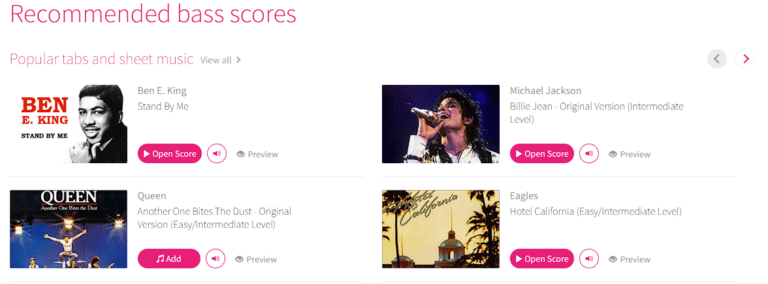
The library size is huge, featuring thousands of songs across a wild variety of styles. From Bruno Mars to Bach, Pearl Jam to Paul Simon, Tomplay is sure to have music you’re into. Honestly, I think it is just as important to work on songs that you don’t normally listen to. You may not be into country, but spend some time playing it and you’ll quickly be a root-fifth maestro. Whether you want to groove to Motown or tackle a more complex Jazz piece, you’ll find the sheet music here to keep you engaged.
Complements Structured Learning
This is a crucial point: Tomplay is not a curriculum replacement. You still need a great course to teach you the why behind the notes. This is where the synergy with a program like Pickup Music comes in.
Once you learn the theory and the fingerings in a structured course like Pickup Music, you need to apply it immediately. Tomplay acts as a practice accelerator for your lessons. It is the sandbox where you immediately apply that theoretical knowledge to real-world music. Learn a new scale shape or concept, then pull up a song in Tomplay that uses it. Boom. You’ve successfully moved from “Newb” to “Above Average” a little bit faster.
Eventually, you may wish to join a live band. Until you do, Tomplay can fill that itch you get to play with other musicians.
The Custom Practice Lab: How Tomplay Works Harder Than You Do
The Visuals: Tab, Notation, or Both
Tomplay gives you the flexibility to choose how you want the music presented. For beginners (and those of us who still rely on the occasional tab to be honest), you can use the Tab-only view. For more advanced players who want to sharpen their reading skills, you can stick to standard notation. I personally use the Both view. It helps me associate the tab numbers with the formal notation so I can slowly wean myself off the crutch. I grew up playing and reading music, but in treble clef. My brain really struggles to read bass clef quick enough to play a song. Tomplay helps me with this.
Time Control (Slowing Down/Looping)
We all know the terror of a fast passage. There’s a saying musicians like to throw around (borrowed from the military, I believe): “Slow is smooth and smooth is fast.” Starting faster than you can handle is a recipe for disaster and frustration. The utility of slowing the music down without changing the pitch is essential. I use the time control feature to practice a difficult 4-bar phrase at 50% speed until I nail it, then slowly inch the tempo up. This focus on tackling difficult passages at an above average pace is where the magic happens.
The Mute Button Magic
I’ve dedicated a specific section to this because the Mute Button is the most powerful tool in the app. You can mute the vocals, the accompaniment, or, most importantly, mute the bass track. This is how you take ownership of the low end and dramatically improve your timing.
The practice goes like this:
- Listen to the song with the bass track on to internalize the part.
- Play the song with the bass track on to ensure you are nailing the notes.
- Mute the bass track.
When the bass track is muted, you are forced to listen to the drums and the rest of the band to keep time. If you fall out of the pocket, you immediately know it. It’s the ultimate training for your musical ear and for preparing to play with a real band. I spent 95 percent of the time playing with the bass track muted.
Muting the pro track is a game-changer, but if you’re not sure how this helps, check out my bass practice routine where I show you how to bridge theory lessons with these backing tracks.
Final Thoughts
The Good
- Tomplay is great for motivation and the chance to play for real along with songs you know.
- Superb customization: adjust the tempo, loop difficult sections, mute individual tracks to hear what you want.
- You can print out individual scores and record your own track along with them.
- A huge library of music from a wide range of genres. I regularly go from jazz to metal to country in a single session.
- Playing along with songs, especially if you use the included click track, helps with timing and musicality.
The Not-Quite-Perfect
- For copyright reasons, the songs are all covers. Some sound just like the real artist…and some don’t. That can be distracting.
- This isn’t a structured course like Pickup Music or BassBuzz. This supplements what you’re learning there.
- It’s a monthly subscription, which not everyone is into.
- Although you can use either tab or musical notation, neither is a substitute for trying to learn to play along with a song by ear.
Final Verdict: Should You Spend the Money on Motivation?
The bottom line is simple: Tomplay is an expense, and I only review what I think is worth your money. For me, Tomplay is fun. Apart from all of the benefits of building up your skills, it’s just fun to step in and be the bass player for Bon Jovi or Jamiroquai or Lady Gaga. The ideal user is the learner who struggles with motivation and needs to apply theoretical knowledge to real-world music. If you’ve spent money on a course like Pickup Music and want to guarantee you actually apply the lessons and keep the momentum going, then Tomplay is a no-brainer. It is the crucial piece of the practice puzzle.
It makes practice feel fun, which means you’ll do it more often. And the resource you’ll stick with is the one that works best.
➡️ Ready to finally make practice feel like a Saturday afternoon jam session?