
I don’t know about you, but sometimes you just want someone to tell you what to do. Eventually, you’ll figure out what works and doesn’t work for you, but to get started with any new skill or hobby, it can be nice to have a framework.
If that sounds like you (I know it sounds like me), then I thought I’d share my go to bass practice routine. I try to pick up my bass at least 4-5 times a week and for the last six months or so, what follows in this article is what I’ve done about 90 percent of the time.
So, if you’re just looking for something that can get you started without needing to scroll through a thousand YouTube videos, maybe it’ll help you as well.
Disclosure: Some of the links in this post are ‘affiliate links’. This means if you click on the link and purchase the item, I will receive an affiliate commission.
The Struggle: Why Most Practice Routines Fail
Most of us fall into two camps. The first camp is the “Scale Robot.” These players spend all day on boring exercises. They can play a C Major scale at 160 beats per minute, but if you ask them to actually play a song, they freeze up. They usually quit because, let us be honest, playing scales is about as exciting as watching paint dry.
The second camp is the “Aimless Jammer.” This was me for a long time. I would put on a YouTube backing track and just hit notes that sounded okay. I was having fun, but I was not getting better. I was plateauing because I did not have the tools to express what I was hearing in my head. I was essentially a human washing machine, making a lot of noise but not really going anywhere.
The 1-2 Punch routine solves this by giving you a clear “toolbelt” phase followed by an “application” phase. I tend to play for 45 minutes or so using this routine, but you could certainly make it longer or shorter depending on the time you have. The easiest way to extend is to just keep jamming away on songs.
Phase 1: The Brain Work (20-30 Minutes)
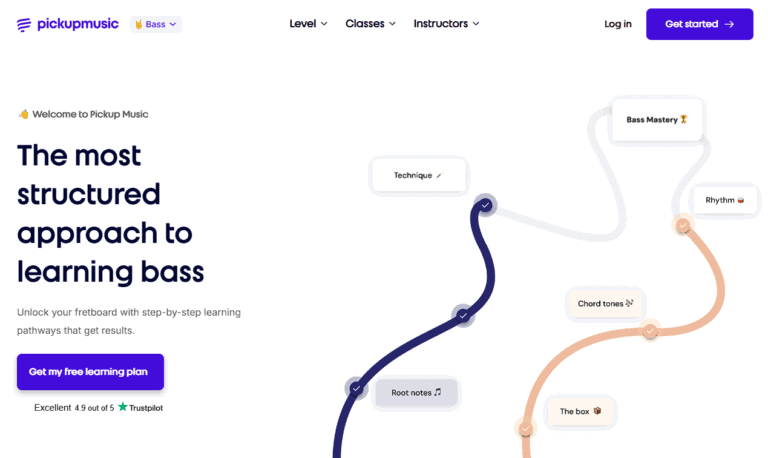
The first half of the routine is what I call the Brain Work. This is where you build your toolbelt. Instead of wandering around YouTube and getting distracted by videos of people turning every possible song into a slap bass monstrosity, I practice using Pickup Music.
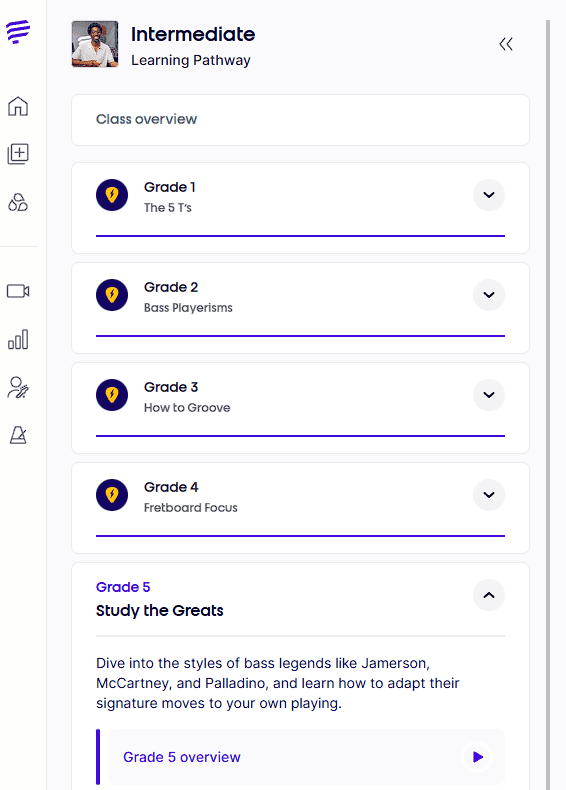
I love Pickup Music because of their “Pathways.” I don’t have to waste time figuring out what to practice. I just click on the next lesson in the Pathway. Each day’s lesson is usually broken down into three or four segments that build on each other and then end with a mini-jam session.
.
For example, a typical session might involve learning the Major Pentatonic shapes and using it for bass fills. It is focused, it is structured, and it actually makes sense. I have spent months testing their curriculum, and if you want to see exactly how their pathways are structured for bass, you should check out my full Pickup Music review here.
The key here is not to overdo it. Spend twenty to thirty minutes getting the theory into your fingers and your brain. Do not worry about being perfect. Just get the shapes down. Think of it like grocery shopping. You are just gathering the ingredients so you can cook something incredible later.
Bonus Tip: If you find that the intervals or scale structures in your daily lesson are a bit confusing, you can quickly brush up on the fundamentals at Musictheory.net before jumping back into your Pathway.
Phase 2: The Application (20-30 Minutes)
Once your brain is a little bit tired, it is time for the fun part: The Application. This is where you take those “tools” you just learned and put them into a musical context.
The tool I use for this is Tomplay. If you have not used Tomplay, it is basically a cheat code for feeling like a pro. It provides high-quality sheet music and backing tracks, but the real “hook” is the ability to mute the “pro” bass track. And I highly recommend muting that track for most of your playing. Otherwise, you’ll be convinced you’re playing much better than you actually are because you’re hearing someone else. Trust me…I speak from experience.
With Tomplay, you are not just playing along to a song. You are the bassist for a real band. There is no “ghost” bass player covering up your mistakes. It is just you, the drummer, and the rest of the band. Tomplay doesn’t feel like “practice.” It feels like fun. Check out my full review of Tomplay here.

You will think you know many of the songs already. After all, you’ve heard them a thousand times. Playing them…that is something entirely different. But that is the point. You see where the gaps are in your playing while actually making music. It is one thing to play a scale against a metronome. It is another thing entirely to hold down the low end when a virtual drummer is staring you down.
Phase 3: The Secret Sauce (How to Combine Them)
This is where the magic happens. The “Secret Sauce” is learning how to bridge the two phases. You do not want these to be two separate islands. You want them to talk to each other.
Let us look at a specific example of how I do this.
In Phase 1 (Pickup Music), I might spend my twenty minutes learning a specific fill using the Major Pentatonic scale. I practice the movement, I get the fingering right, and I understand the intervals. Pickup Music doesn’t typically use original tracks (because of copyright, I imagine.) However, they will tell you it is a piece inspired by James Brown, for example.
In Phase 2 (Tomplay), I do not just play any random song. I find a track in that same style. Often, you can find the exact song Pickup Music is basing their lesson off of.
Suddenly, that “classroom” lesson from twenty minutes ago has turned into a “live” gig. You are not just “learning the Major Pentatonic.” You are playing a fill that sounds like something that James Brown got down to with his bad self. That is how you turn information into an actual skill. These skills will help you tremendously at your first real jam.
Why This Works for the “Above Average” Journey
I am not a pro bassist. I can’t figure out slap bass, and I still get nervous at open mic nights. But this routine has stopped me from hitting that intermediate wall that stops so many people.
It works because it respects your time and your motivation. If you only do theory, you will get bored and quit. If you only jam, you will get frustrated by your lack of progress and quit. By splitting the difference, you get the satisfaction of learning and the joy of playing every single day.
I am still using these resources in my own journey. I am still the guy who buys a new pedal because I am convinced it will magically make my “ghost notes” sound better. But the foundation is this routine. It is about getting better, together.
Conclusion: Stop Randomly Practicing
If you are tired of “sucking” at bass, the first step is to stop practicing randomly. Pick a path, find a song, and bridge the gap.